
“And it is in this strange interstice that the United States now finds itself—at a narrowing crossroads, its economic dominion trembling beneath the burden of a USD 37trn debt, rising prices that corrode the soul of the common denizen, and a dollar that once reigned supreme across the earth but now quivers beneath the weight of its own contradiction.” — Jamin Thompson, 2025
Two years had passed since September 11, 2001, and I was diligently studying US anti-money laundering rules in preparation for what would be a fairly brief — but impactful — role writing for a world-renowned anti-money laundering expert. The USA Patriot Act of 2001 ushered in sweeping changes to how money was tracked and who was allowed to use it. The idea was that acts of terrorism could be stopped if the flow of money were tracked via a central database capable of detecting dangerous patterns.
Though, many have recently noted that the use of the label “terrorism” has broadened so significantly that it may as well include the methods utilized by those who proclaim to battle it. “Terrorism functions as a floating signifier lacking a precise referent,” wrote professor John Keane, founder of the Centre for the Study of Democracy, in a February 2024 Substack post.
One of my first revelations upon arriving at my new job in Miami was that anti-money laundering experts have a wide range of friends. Some of them were high-ranking government officials. One of them, who worked in port security, told me that actual terrorists do not operate via the movement of money. They operate through the movement of things — such as people and weapons.
Another revelation was the sheer chaos that ensued upon the enforcement of these new anti-money laundering, anti-terrorist financing rules. The amount of paper forms generated by the money-tracking requirements — especially at casinos — was tremendous. Every transaction totaling greater than USD 10,000 required a special report; every suspicious transaction totaling more than USD 5,000 also required a special report. US casinos move millions of dollars every day. The money-tracking system operated in paper forms at the time, which had to be filled out by employees and sent to special processing centers, where the information on the forms would be manually entered into a database.
One casino employee was so overwhelmed by the volume of forms he was required to process, he “snapped,” and began stuffing the forms in his car and in the drawers of his desk; even more forms were discovered at his home. The errors involved in processing information, in addition to the delays in transcribing and recording, resulted in months if not years of lag time between a transaction’s report and its appearance in any sort of searchable database. The US Treasury Department mandated electronic entry of transaction reports in 2013, twelve years after the enhanced tracking measures were signed into law.
The third revelation I had was when I was speaking to a man who had been hired to assist the current US government administration to build a “cloud” database that would be capable of tracking all monetary transactions, in addition to phone calls, text messages, electronic messages, web browsing and more. I wondered, if those who commit acts of terror do not use money to do so, what is the purpose of the assembly of the database? In the years following the implementation of Patriot Act rules, acts of terror increased significantly, reaching a peak in 2014, when 32,272 lost their lives, according to widely adopted definitions of such attacks.
“Terrorism is the threat or use of violence to intimidate or coerce in the pursuit of political or ideological goals. It is usually understood to be done by non-state actors — individuals or organizations not part of the government.” — Our World in Data.
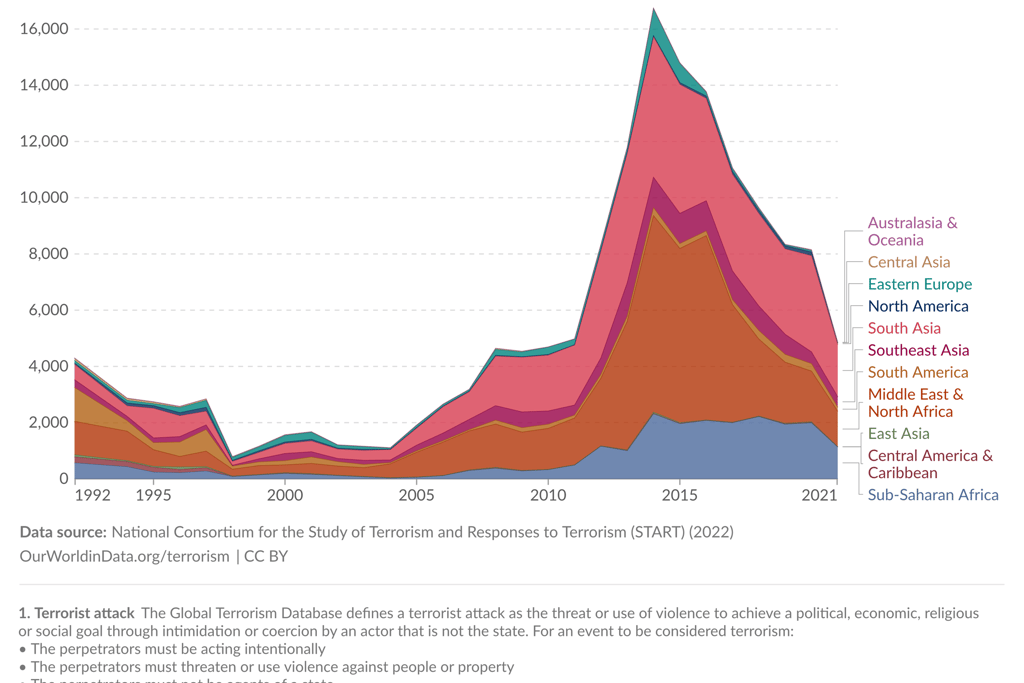
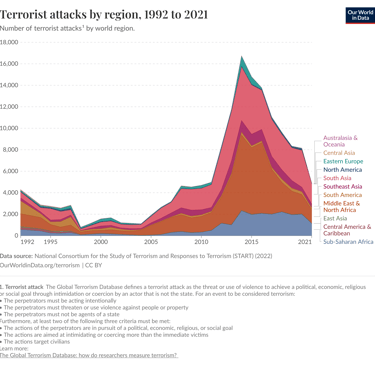
Meanwhile, more than 940,000 people were killed by direct acts of war in Afghanistan, Iraq, Pakistan, Syria and Yemen between 2001 and 2023, according to Brown University’s Cost of War research. Nearly half of these deaths were civilian. The number of indirect deaths as a result of the wars’ destruction of economic and health infrastructure is estimated at 3.6-3.8 million people, according to the university’s research. This amounts to approximately 227,000 deaths each year.
More than 3,600 deaths have been reported in Iran alone since the US began strikes in the region on 28 February; of these deaths, at least 1,600 were civilians.
New definitions of terrorism and unlocked tracking measures “granted the US unprecedented legal authority to bypass traditional war declarations, conduct lethal operations globally, and freeze assets without relying on conventional law enforcement. By equating non-state groups to armed combatants, the US gained the power to target them militarily while aggressively penalizing any foreign power providing them aid,” according to a collection of 2002 documents held in The White House Archives.
“The Bush administration’s framework for countering terrorism … permitted operations in countries with which the United States was not at war, the indefinite detention of suspected terrorists without trial, and military tribunals instead of civil trials,” the Cato Institute wrote in a June 2017 policy analysis.
“The chain reaction of evil — hate begetting hate, wars producing more wars — must be broken, or we shall be plunged into the dark abyss of annihilation." — Martin Luther King Jr. said in a 1957 speech.
Based on the rate of terror-inducing acts — whether classified as terrorism or war — the tracing of money may not be the answer, unless one applies a different lens. Is money, in this case debt-based currency, at the root of all of this conflict?
Whether we are speaking of the cognitive framework or its physical manifestation, the answer seems to be yes. It is certainly the mind operating in a belief in separation which would justify warfare or acts of terror at any scale. Between 2001 and 2021, the US spent more than USD 8trn on acts of war, according to Brown.
"Faced with a fading hegemony, a declining superpower often shifts from a predictable global stabilizer to an erratic, highly volatile force. It begins to rely almost entirely on its military leverage, lurching from one intervention to the next, as its political and economic tools lose their grip on the world," wrote Paul Kennedy in The Rise and Fall of Great Powers, 1987.
While it seems plausible that this money could have been used for humanitarian purposes, the reality is that debt-based currency must maintain economy of scale in order to survive. What this means is that there must always be currency worth less than the dominant, or reserve, currency. If the dominant currency loses its ability to maintain production power over every currency nested beneath it, it will not only collapse, but bring every other central bank currency with it.
“The world is edging toward a financial storm with few safe harbours in sight,” wrote Dennis Snower, founding president at the Global Solutions Initiative and international research fellow at Oxford University’s Said Business School, in November 2025. “If the dollar’s dominance collapses, the world will not transition neatly to a new order - it will splinter,” he wrote.
What is production power? Production power is a single currency’s ability to dictate the rate at which goods and services are consumed. Production power is essentially a tempo, like time, that sets the global rate of debt repayment. When production slows, consumption slows; when production increases, consumption increases. Interruptions to this balance of power have historically been mitigated through war, or agreements such as that of the petrodollar, which was enacted by Saudi Arabia and the US between June 8, 1974 to June 8, 2024.
The agreement ensured that the world’s most widely traded commodity — oil — would be priced in US dollars; moreover, profit from oil sales would be reinvested in US currency. In exchange, the country was promised US military protection. Additional oil-producing nations followed suit, largely out of market necessity. The end of the petrodollar agreement, in addition to the United Arab Emirates’ exit from the Organization of Petroleum Exporting Countries (OPEC) in May, signals an inevitable end to US Dollar dominance vis-a-vis the end of the petrodollar. The USD’s reserve status fell from more than 70% prior to the year 2000 to just over 56% at present day.
A currency is considered a reserve currency due to its presence on the balance sheets of global central banks. Like savings accounts, central banks hold currencies as financial cushions, in addition to tools for exchange of goods and services. By virtue of holding one dominant currency, countries world-wide could exchange goods in one currency, avoiding the expense of continual exchange. Labor, however, would still be paid in the country’s local currency, resulting in the ability for stratification of worth among all of the world’s currencies. It was this stratification of worth that ensured the purchasing power of the world’s dominant currencies retained the greatest strength.
Acts of war and/or terrorism destabilize economies, resulting in low labor costs, low currency value, and therefore low export value on critical exports — such as petroleum, precious minerals, and more. This perpetuates unequal distribution of world resources and unequal treatment among our global population; the labor of a human being in one part of the world is valued less than or greater than the labor of a human being in another part of the world.
When a country suppresses its domestic wages and implements austerity to back a stable, un-inflated reserve currency system, it creates what political economists call an income deflation. This artificial income squeeze forces local populations to reduce their food intake, causing physical degradation and more, Utsa Patnaik and Prabhat Patnaik wrote in “A Theory of Imperialism,” 2017.
The rise of a more diverse set of reserve currencies held on central bank balance sheets, including the USD, the Euro, and to some extent the Remnibi and Yuan, is more an effect of the end of the petrodollar than anything; without trade domination over a resource utilized world-wide, the collective desire to maintain dollar dominance wanes. Some Middle Eastern countries are no longer seeking safety and security from the same force which seeks continual destabilization in the region. .
“Gulf allies are no longer willing to be the lightning rods for US military campaigns while relying on uncertain protection when retaliation arrives. And once allies learn they can say ‘no’ to Washington, they rarely return to automatic obedience,” wrote professor and geostrategist Brahma Chellaney, in a 14 May editorial in The Hill.
When financial interdependence wanes, so too do geopolitical alliances. China’s e-CNY, the EU’s digital Euro, and several BRICS payment experiments all intend to bypass dollar-based networks like SWIFT, Snower wrote. Parallel payment infrastructures serve to fragment financial oversight and weaken global coordination, he wrote.
In the same manner, dominance of petroleum and petroleum-based exports may loosen as alternate payments systems rise. As a result of the cognitive shift underway now, resource extraction and stratification of labor value will no longer be linked to currency. Without a valuation anchor such as the USD et al, currency will be viewed synonymously with that which is tangibly present on earth in any given moment. It is not a force which must be harvested and monetized in order to achieve value. Rather, it is the value.
When do we reach the tipping point?
In the days leading up to the 2008 Financial Crisis, investor appetite began to wane for highly leveraged debts backed by subprime mortgages. At that time, we had an explosion of debt innovations, brought to the world by engineers capable of designing structures to reference — but not actually hold — subprime mortgage and other debts. Like layers of scaffolding, additional structures were then created which referenced the ones which preceded them. The structured debt containers outpaced the issuance of underlying subprime mortgage debt by at least four-to-five times, according the Federal Reserve Bank of Philadelphia. US subprime mortgage debt outstanding at its height was somewhere around USD 1.3trn, according to the bank, compared to at least USD 4trn to USD 5trn in structured debt which referenced it.
Overall, the preponderance of structured debt provided a series of suitable containers to hold the expansion of USD world-wide. In late 2007, the USD’s share of global currency reserves hovered around 62% - 64%, according to Congress.gov. This amounted to non-US holdings of US Treasuries and so-called prime, or agency, mortgage debt in the USD 4.5trn range in mid-2007, according to US Treasury data. Total US debt stood at USD 10trn, compared to USD 39trn at present, according to Treasury data.
While the numbers themselves are challenging to balance, particularly as one person’s debt is another’s presumptive asset, the pattern of leverage is ever-present. Leverage is empowering an expansion of debt, or USD currency. Signs of erosion in subprime mortgage credit quality led rating agencies to downgrade large swaths of the debt, which in turn led to a series of technical defaults in the structured investment vehicles which held them.
The vehicles were designed to unwind when the ratings of the underlying debt plummeted. Suddenly, billions of dollars of subprime mortgages were presented to investors at fire sale prices, and US home prices sunk as much as 48% from peaks reached just months earlier. Housing market distress was immediately a dire currency event, as a loss of debt valuation — in many cases down to zero — was a loss of currency outstanding. Credit was difficult to obtain. Foreign investors endured tremendous losses on US debt holdings, a situation which eventually led to the Eurozone crisis.
Why? The decline in US credit outstanding hit the most vulnerable countries — such as Greece — due to an equivalent decline in surplus cash held on hand at their respective central banks. The cost of living increased dramatically, in turn spurring a loss of faith in the country’s currency. Global reserve currencies act as a clock; they set the pace for buying and selling of goods and services. When the clock suddenly moves very slowly, the countries whose currencies are tied to the global reserve currency are extremely vulnerable to collapse due to an inability to issue new currency to cover the loss of time.
The so-called Triffin Paradox was the root cause of the 2008 economic disorder, Zhou Xiaochuan, governor of the People’s Bank of China said in a March 2009 speech. The Triffin Paradox is named after Robert Triffin, who first identified the struggle faced by countries whose currency is used as a world reserve currency in the 1960s. Even before the USD was no longer redeemable in physical gold, the US began to transition from a creditor nation to a debtor nation, due to the inevitability of trade inbalance caused by global demand for dollars.
Consider though, that at some level, there is an expectation of payment for debts. It is the expection of debt payment that creates the book value of an asset. Now consider that there are relatively few global citizens paying debts in comparison to the anticipation of debt payment outstanding. This is where we can draw similarities between the subprime mortgage meltdown and the meltdown of an entire currency system. That which backs a currency is ultimately the belief that it holds value; the belief that it holds value hinges on the expectation that this relatively small pool of global citizens will continue paying their debts.
The paradox Triffin described was a continual erosion of the quality of life for the citizens which live in a country which issues the global reserve currency, despite the inherent privilege of wealth generation. When a currency grows as a result of not only new debt issuance but faith that payments on the debt will occur, it creates a manner of life which is increasingly focused on debts. Compounding matters, citizens are most commonly in debt to purchase foreign products, a phenomenon which “hollows out” such economies of manufacturing and production jobs which typically support higher wages. In turn, citizens create more debt just to live. This is after all, the cost of keeping the currency growing.
One of the most fascinating case studies of this is in regard to student loans. Student loan debt exploded in the years following 2008, when total debt outstanding grew from roughly USD 516bn in 2007 to USD 1.86trn today. The average balance per borrower rose from USD 18,000 to USD 43,500, and the number of student loan borrowers rose from 28 million to 43 million.
The dollar volume of currency generated by the three-fold increase in student loan debt is likely at least four times the USD 1.86trn outstanding, based on historical trends. (Prior to the 2008 financial crisis, subprime mortgages outstanding were USD 1.3trn, compared to at least USD 4trn to USD 5trn in structured debt which referenced it.) If we estimate that at least USD 7.4trn in currency outstanding is reliant on the perception that student loan borrowers will continue to pay their debts, the treatment of student loan borrowers begins to make sense — from stories of loans quadrupling in size during forbearance to epic battles surrounding student loan forgiveness.
For decades, student loan borrowers were erroneously told they could not discharge their debt in bankruptcy, according to a monumental US Bankruptcy Court for the Southern District of New York ruling in 2020. Student loan borrowers seeking bankruptcy relief are subject to basic standards of ability to pay in the present moment — not what they could hypothetically pay in the future or the past, said Judge Cecelia Morris.
While the majority of student loan debt sits directly on the US Government’s balance sheet, it serves as collateral for additional debt issuance just like subprime mortgages did in the run-up to 2008. At the end of the day, debt is debt, and currency is currency. Faith in the USD — vis-a-vis its citizens’ debt — could falter ahead of an actual default event. It was in the wake of the 2008 default events that Brazil, Russia, India, China and South Africa began discussing a payment network (BRICS) capable of circumventing the USD. BRICS nations now total eleven, with additional members Saudi Arabia, the United Arab Emirates, Egypt, Ethiopia, Iran and Indonesia.